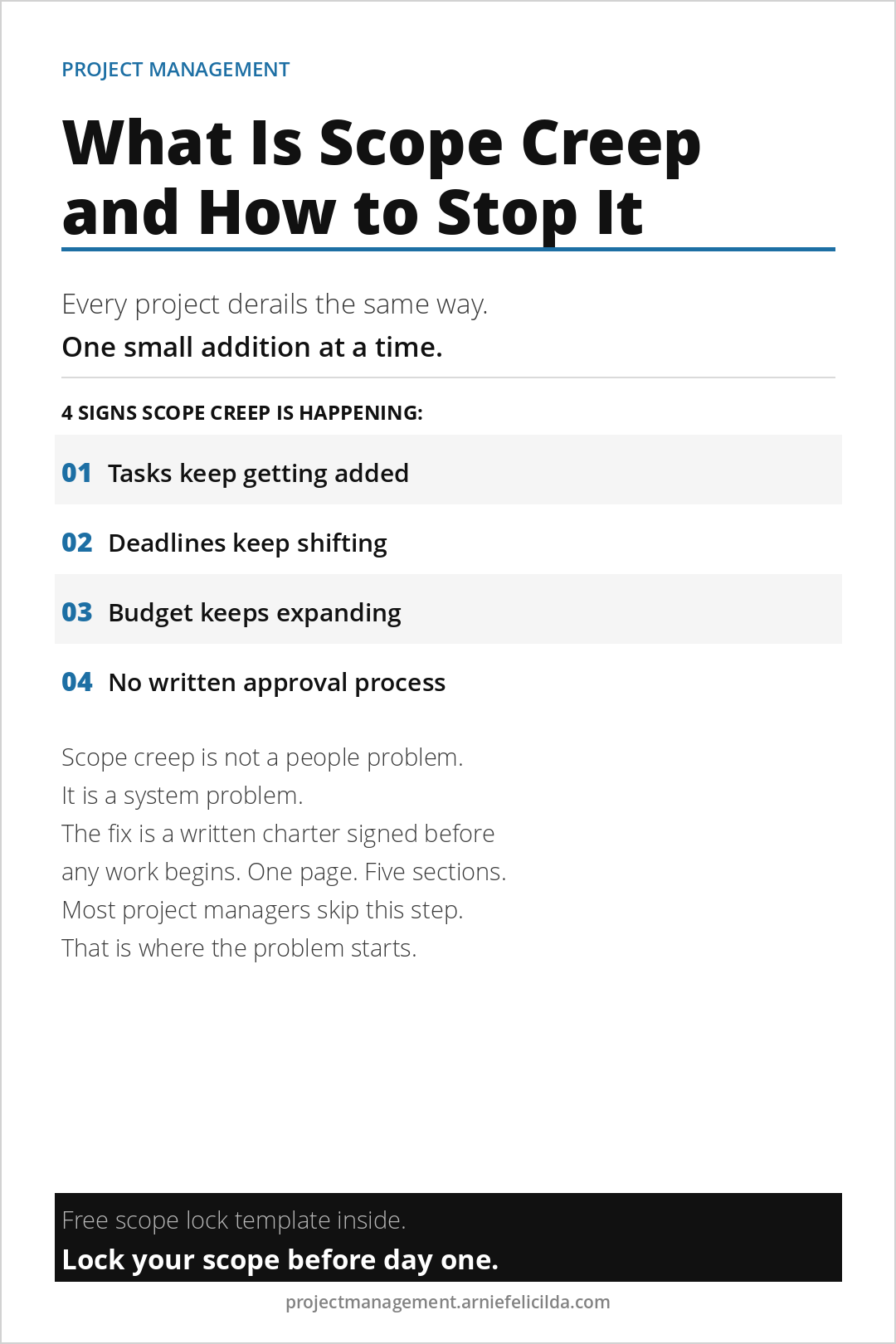
Scope creep is what happens when a project grows beyond its original boundaries without a formal approval process. It does not happen all at once. It happens one small addition at a time. A new feature here. A revised deliverable there. An extra report someone asked for in a meeting. Each one seems reasonable. Together, they push every deadline back and stretch every budget past its limit.
It is one of the most common reasons projects run late, run over budget, or never finish. Understanding what it is and how to stop it early is the single most useful skill you can build as someone running projects without formal training.
What Scope Creep Looks Like in Practice
Scope creep rarely announces itself. It shows up in small moments. A stakeholder asks if the team can just add one thing. A sponsor says the original plan needs a small update. A team member assumes a new task is included without checking. None of these feel significant in the moment. That is what makes scope creep so effective at derailing projects.
By the time most project managers notice the scope has expanded, three things have already happened. The timeline has shifted. The team is stretched. The original deliverable has quietly changed into something different from what was agreed. This pattern shows up on every project that runs without a written scope document.
The definition that matters: Scope creep is any change to the agreed project scope that was not formally reviewed, approved, and documented. It does not matter how small the change is. If it was not written down and signed off, it is scope creep.
4 Signs Scope Creep Is Already Happening
1. Tasks Keep Getting Added Without Removing Others
Every project has a fixed amount of capacity. When tasks are added without removing or reprioritizing others, the team absorbs the extra work silently. Deadlines slip. Quality drops. The project manager is often the last to know because the team keeps saying yes to avoid conflict.
2. Deadlines Keep Shifting Without a Documented Reason
A deadline that moves once without explanation is a scope problem. A deadline that moves repeatedly is a system problem. Every date change should have a written reason tied to a specific change in scope, resource, or dependency. Use the free weekly progress dashboard to track milestone shifts as they happen so nothing slips quietly past you.
3. Stakeholders Are Sending Requests Directly to the Team
When stakeholders bypass the project manager and send requests directly to team members, scope gets added informally. Team members often say yes because they want to be helpful. The project manager finds out later, when the timeline is already affected.
4. The Project Charter Has Not Been Referenced Since Kickoff
The project charter defines the original scope. If no one has looked at it in weeks, it is not being used as a control document. Scope drifts when there is no active reference point. Read more about building one in What Is a Project Charter and Why Every Project Needs One.
How to Stop Scope Creep Before It Starts
Define Scope in Writing Before Work Starts
A project charter that clearly states what is in scope and what is explicitly out of scope is the foundation of scope management. The out of scope section is as important as the in scope section. If it is not written down, someone will assume it is included. Use the free Project Charter Workbook to write yours in under 20 minutes.
Create a Written Change Request Process
Every scope change request should follow the same path. Written request, impact assessment covering time, cost, and resources, then approval from the project sponsor before work begins. No exceptions. A verbal approval in a hallway is not an approved change request.
Check Your Scope Risk Before the Project Starts
Use the free Scope Creep Risk Checker to score your project against the most common scope vulnerabilities. It takes five minutes and tells you exactly where your project is at risk before a stakeholder meeting turns into a scope negotiation.
How to Handle a Scope Change Request Professionally
When a stakeholder requests a change, the professional response is not a yes or a no. It is a process. Say this: I need to assess the impact on our timeline, budget, and resources before we can commit to that change. I will come back to you within 24 hours with what it will take.
That one sentence does three things. It acknowledges the request without committing to it. It signals that changes have real consequences. And it positions you as someone who manages projects deliberately rather than reactively.
After the assessment, present the impact clearly. This change adds three days to the timeline and requires four additional hours of design work. To include it, we need to either extend the deadline or remove an existing deliverable. Which would you prefer?
If you are running projects without formal training, The Accidental Project Manager covers the complete scope lock system with templates you can use on your next project immediately. The book is built for people who were handed a project and had to figure it out as they went.
Scope creep is preventable. Not by being difficult or uncooperative, but by having a clear system and using it from the first day of the project through the last. Start with a written charter. Build a change request process. Use the Scope Creep Risk Checker before kickoff.
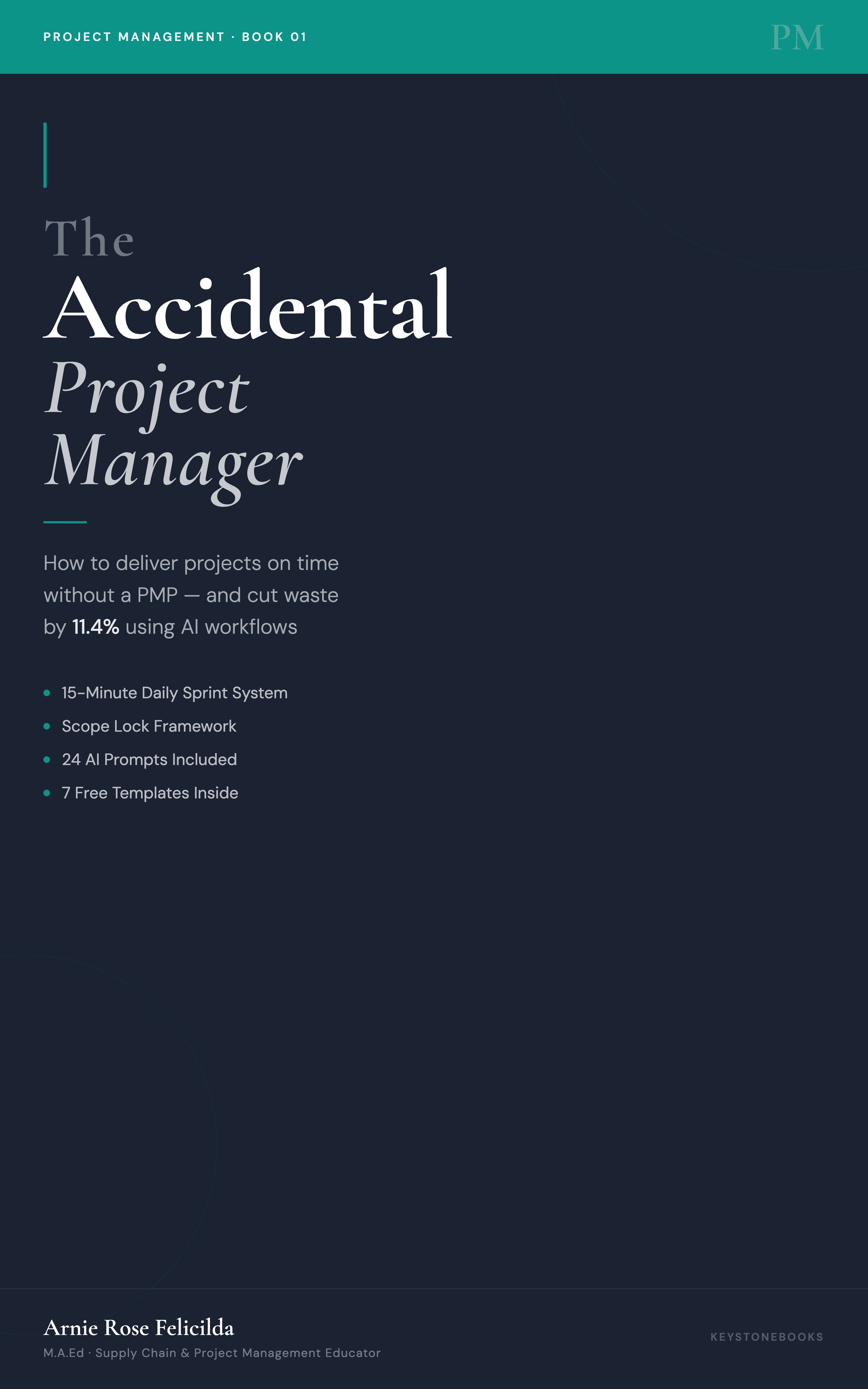
Book 01. Available Now
The Accidental Project Manager
How to deliver projects on time without a PMP and cut waste by 11.4% using AI workflows. 15-Minute Daily Sprint System, Scope Lock Framework, and 24 AI Prompts included.
Get the BookMore Project Management Reads
- How to Stop Scope Creep Before It Derails Your Project
- How to Manage Projects Without a PMP
- How Operations Managers Can Actually Use AI on Projects
- The Difference Between a Busy Project and a Healthy One
- How to Recover a Project That Is Off the Rails
Free Project Management Tools
Get free tools built for people who run projects without formal training.
Charter template, sprint system, dashboard, recovery checklist, and AI prompt library. All free. Delivered instantly.