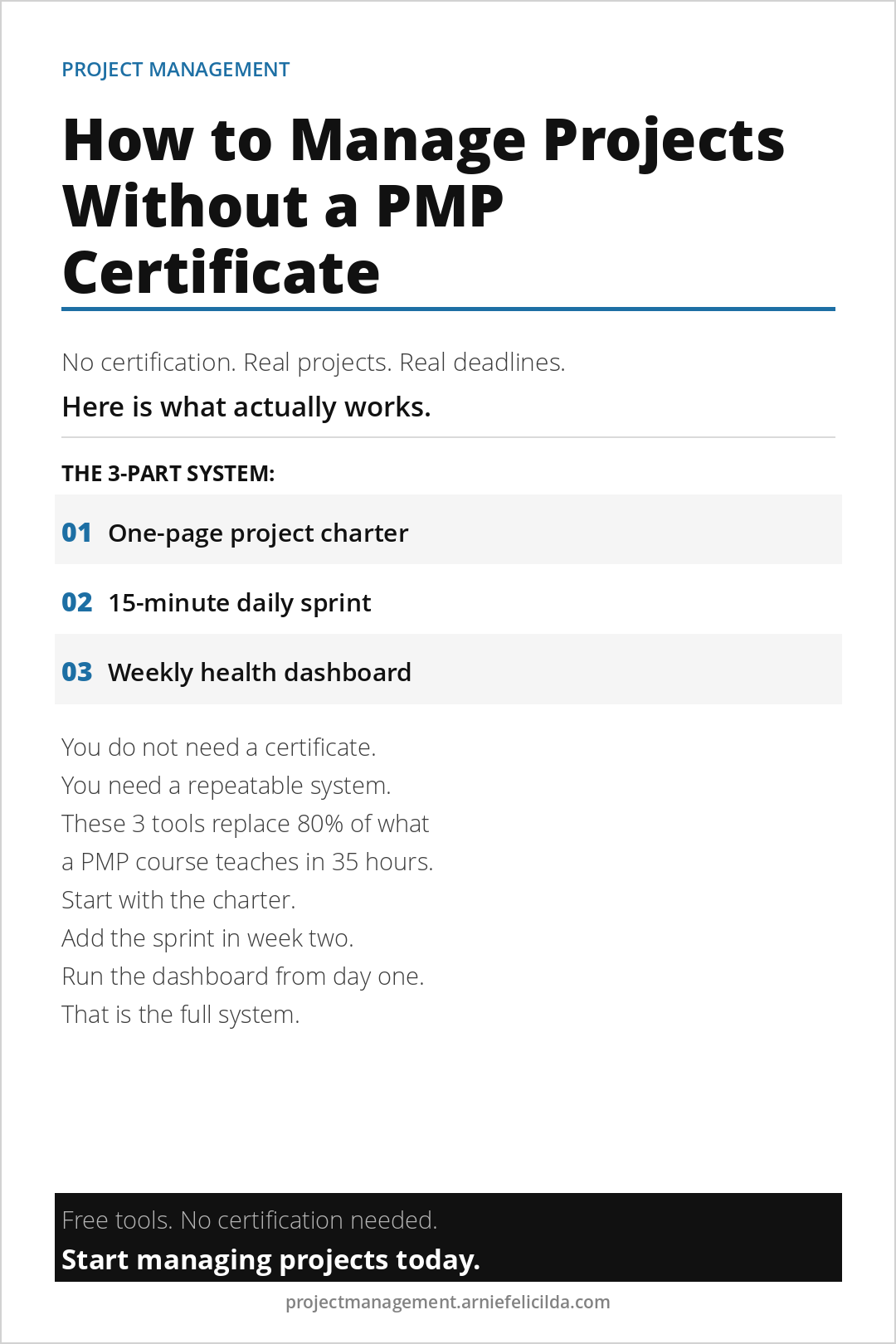
You were handed a project. Nobody trained you for this. You were good at your job, someone trusted you with a deliverable, and suddenly you were responsible for timelines, stakeholders, budgets, and decisions you had no formal system to manage. If this is your situation, you do not need a PMP certificate before you can manage projects well. You need a system you can start using today.
This post lays out exactly that system. Three tools. No jargon. No certification required.
Why You Do Not Need a PMP to Run a Project Well
The Project Management Professional certification is a respected credential. But it is designed for experienced project managers who want to formalize knowledge they have already built through years of practice. It is not designed as a starting point. For someone managing their first or second project right now, it is the wrong tool for the immediate problem.
What you need right now is not a certificate. It is a system. Specifically, three tools that work together to keep a project moving, visible, and on track without requiring advanced knowledge or expensive software. Most projects fail not because the manager lacked certification but because no one defined the scope clearly or communicated proactively with stakeholders. All three of those problems have simple solutions that require zero certification.
Most projects fail not because the project manager lacked certification, but because no one defined the scope clearly, no one tracked progress consistently, and no one communicated proactively with stakeholders.
The 3-Part System for Managing Projects Without a PMP
Part 1. The One-Page Project Charter
Before any project starts, write a one-page charter. It needs to answer five questions in writing. What is the project goal in one sentence? What is in scope and what is explicitly out of scope? What are the key milestones and their dates? Who approves decisions when the team is split? What does success look like at the end? Use the free Project Charter Workbook to build yours in under 20 minutes. Get every key stakeholder to agree on the answers before work begins. This single document prevents the majority of scope disputes, timeline arguments, and stakeholder conflicts that derail projects. Read the full breakdown in What Is a Project Charter and Why Every Project Needs One.
Part 2. The 15-Minute Daily Sprint
Every morning before any meetings or reactive work, spend 15 minutes on three questions. What moved forward yesterday? What are the three most important tasks for today? Is there anything blocked that needs to be escalated today? Write the answers down. Send a one-line proactive update to your key stakeholders. Use the free 15-Minute Daily Sprint tool to run this system every morning. It takes 15 minutes and eliminates most of the follow-up questions you receive throughout the day.
Part 3. The Weekly Progress Dashboard
Once a week, run a three-number health check on your project. What percentage of milestones are on track? How many open risks are currently unresolved? How does actual spending compare to planned budget? Color code each number. Green for on track, amber for watch this, red for act today. Use the free Weekly Progress Dashboard to track all three numbers in one place and share them with your sponsor every Monday. This weekly check-in prevents the gradual drift that causes projects to arrive at a missed deadline without anyone noticing.
What to Do When Something Goes Wrong
Every project has problems. The difference between a project manager who handles them well and one who does not is the speed and clarity of the response. When something goes wrong, stop adding new work immediately. Identify the root cause rather than the symptom. Build a revised plan with a new baseline. Get written approval from your sponsor before restarting. Read the full recovery process in How to Recover a Project That Is Behind Schedule.
When to Get the PMP Certificate
Get the PMP when you have two or three years of practical project management experience and you want to formalize your knowledge or advance your career. Do not wait for the PMP before managing your first project. The certification teaches you what you should already be doing. Start doing it now with the three tools above.
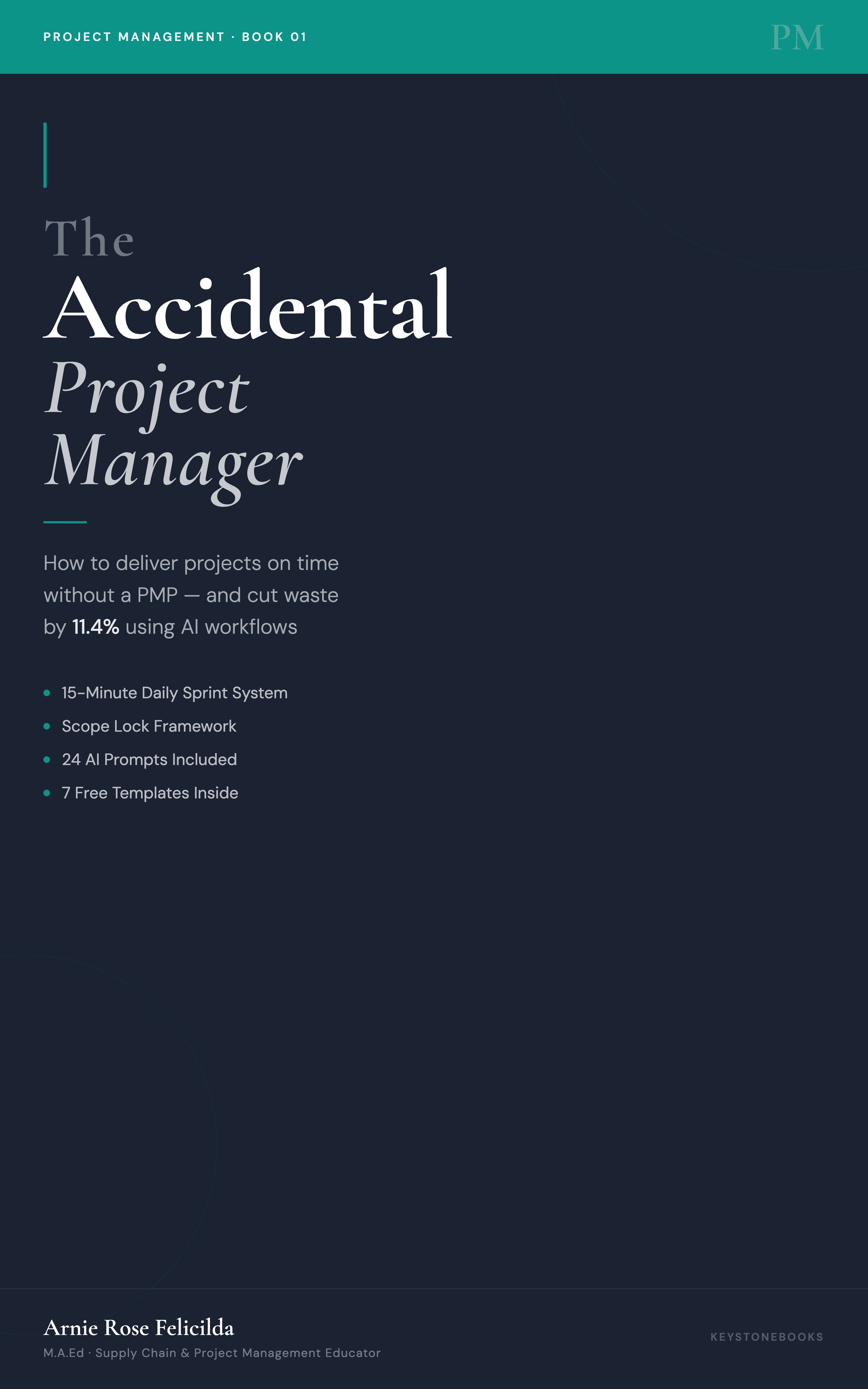
If you want the complete system in one place, The Accidental Project Manager covers all three tools plus scope locking, stakeholder management, AI workflows, and project recovery. It was written specifically for people who were handed a project without formal training and needed a system that works from day one.
Book 01. Available Now
The Accidental Project Manager
How to deliver projects on time without a PMP and cut waste by 11.4% using AI workflows. 15-Minute Daily Sprint System, Scope Lock Framework, and 24 AI Prompts included.
Get the BookMore Project Management Reads
- How to Stop Scope Creep Before It Derails Your Project
- How to Manage Projects Without a PMP
- How Operations Managers Can Actually Use AI on Projects
- The Difference Between a Busy Project and a Healthy One
- How to Recover a Project That Is Off the Rails
Free Project Management Tools
Get free tools built for people who run projects without formal training.
Charter template, sprint system, dashboard, recovery checklist, and AI prompt library. All free. Delivered instantly.