Most project managers who struggle with underperforming team members are not struggling because they do not know what needs to happen. They are struggling because the conversation feels uncomfortable. The discomfort is real. So is the cost of avoiding it.
Why the Conversation Needs to Happen Early
A team member who is two days behind on a deliverable can usually recover. One who is two weeks behind rarely can without affecting the project timeline. The earlier a performance problem is addressed, the more options exist for resolving it.
The most common reason project managers wait too long to address performance issues is the hope that the situation will improve on its own. It almost never does. Performance problems that resolve without intervention are the exception, not the rule.
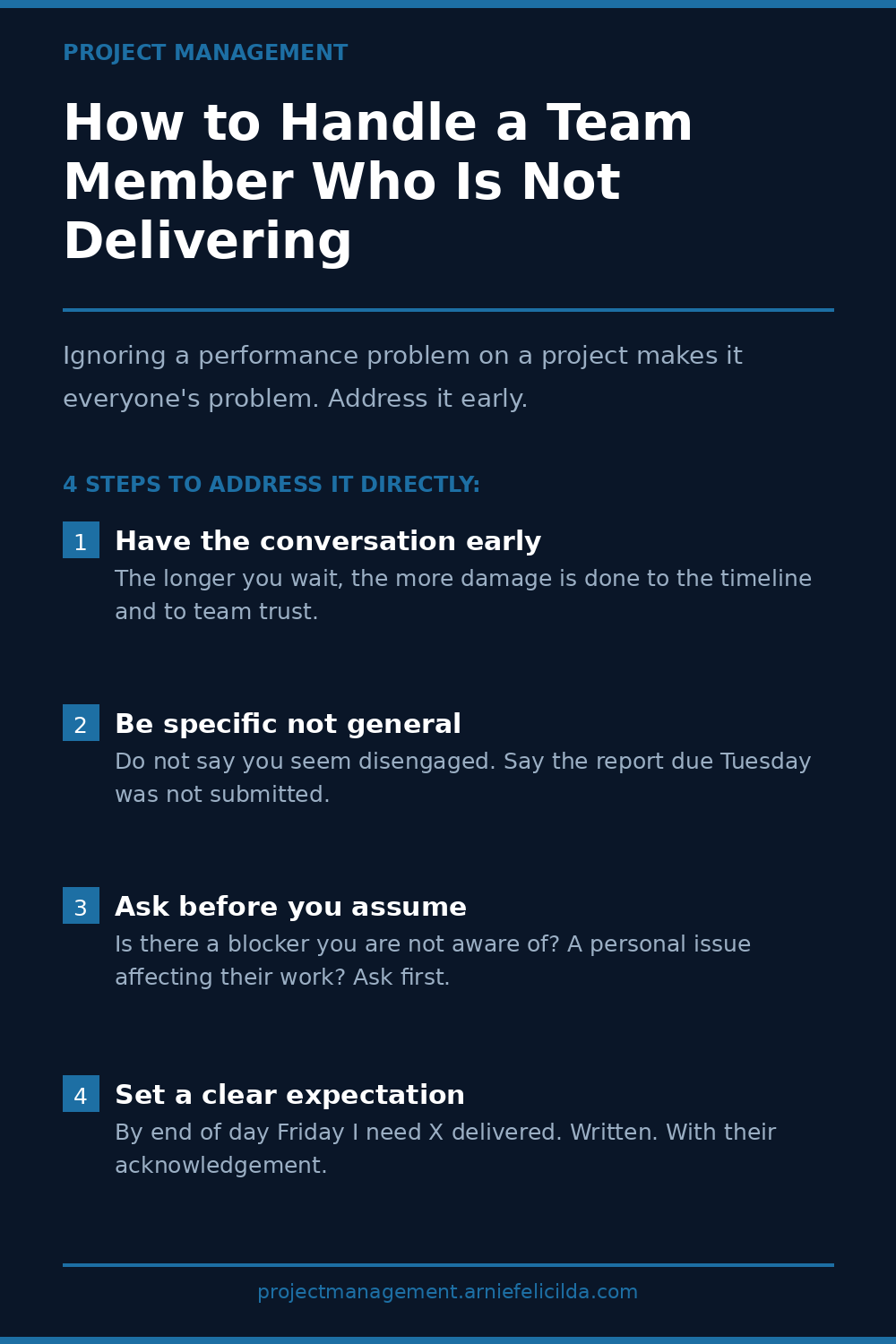
4 Steps to Address It Directly
Have the Conversation as Early as Possible
The moment you have evidence - not suspicion, evidence - that a team member is not delivering, have the conversation. Not an accusatory confrontation. A direct, specific conversation. The longer you wait, the more you communicate that the situation is acceptable.
Be Specific, Not General
Do not say you seem disengaged or your performance has been declining. Say the requirements document was due Tuesday and was not submitted. I want to understand what happened. Specific observations are harder to dispute and lead to productive conversations. General observations lead to defensive ones.
Ask Before You Assume
Before assuming the team member is not trying, ask what is happening. Is there a blocker you are not aware of? A personal situation affecting their capacity? A misunderstanding about the scope or priority of the work? Ask directly. The answer sometimes changes how you proceed significantly.
Set a Clear, Written Expectation
End the conversation with a specific expectation. By end of day Friday, I need the requirements document reviewed and submitted for approval. Write it down. Send it in a follow-up message. Ask for acknowledgment. Verbal expectations are remembered differently by different people. Written ones are not.
When the Problem Continues
If the team member does not improve after a direct conversation with specific expectations, escalate to the project sponsor or the team member's line manager. This is not a failure of the project management process. It is the process working correctly. Your role is to surface the performance risk. Someone else's role is to decide what to do about it.
For more on this topic, read How to Manage a Remote Project Team. You may also find How to Get Stakeholder Buy-In Before the Project Starts useful as a next step.
Available Now
The Accidental Project Manager
For the person who was handed a project and told to figure it out. The 15-minute daily system, scope lock framework, and AI prompts that get any project back on track. No certification required.
Get the Book on Gumroad