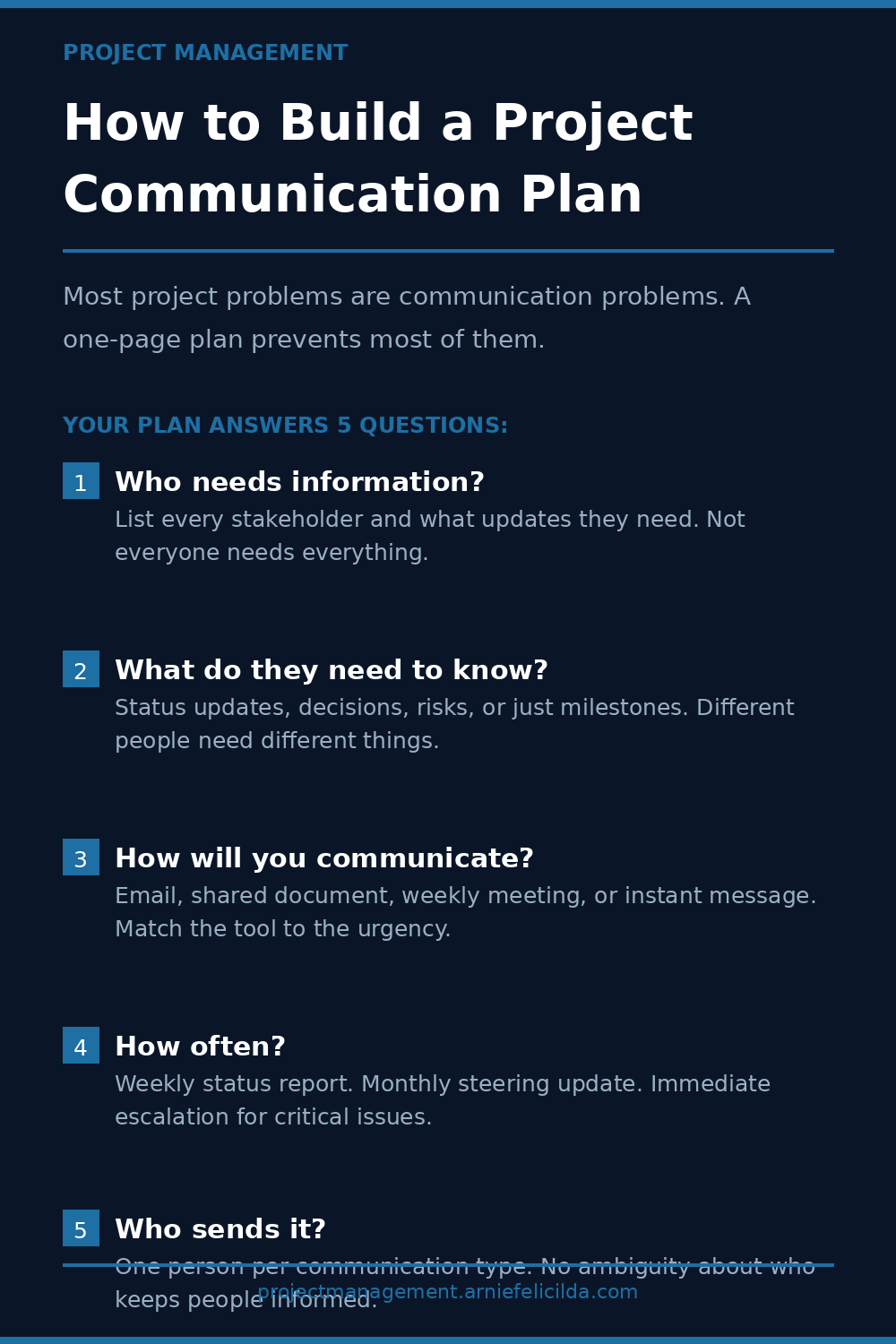
A communication plan is not a complex document. It is a one-page agreement about who gets what information, how often, through which channel, and from whom. It exists to prevent the two most common communication failures: over-communication that nobody reads and under-communication that leaves key people uninformed.
Why Communication Plans Get Skipped
Most project managers believe their communication instincts are good enough. They will know who needs to know what. They will keep stakeholders informed. This works when projects are small and stakeholders are few. It fails when complexity increases and the informal network can no longer carry the load.
A communication plan does not need to be elaborate to be effective. A one-page table that answers five questions is enough to prevent the most common communication failures on most projects.
5 Questions Your Communication Plan Must Answer
Who Needs Information?
List every stakeholder by name and role. Then identify what category of information each person needs: strategic updates, operational details, risk and issues, or just milestone completions. Not everyone needs everything. Sending everyone everything creates noise that causes people to stop reading your updates entirely.
What Do They Need to Know?
For each stakeholder, specify the type of content they receive. The steering committee needs project status, budget variance, and key risks. The development team needs task assignments, deadline changes, and technical decisions. Tailored content gets read. Generic content gets skimmed.
How Will You Communicate?
Match the channel to the type of information and the urgency. Routine status updates go by email or shared document. Decisions that need discussion happen in meetings. Urgent issues get a phone call or instant message. Establishing these norms prevents the situation where critical information gets buried in a weekly email thread.
How Often?
Weekly status report for most project stakeholders. Monthly summary for executive stakeholders. Immediate escalation for anything that creates a red status or affects a confirmed delivery date. Define each frequency explicitly so stakeholders know when to expect information and do not fill the gap with direct queries to the project manager.
Who Sends It?
One person is responsible for each communication type. The project manager sends the weekly status report. The project sponsor communicates steering committee decisions. The technical lead sends team updates. When there is ambiguity about who sends something, it often does not get sent.
When to Build the Communication Plan
During project planning, before the kickoff meeting. Share it at the kickoff. Ask for agreement. Update it when the stakeholder list changes or when communication is not working as intended. A communication plan that is never updated is a planning artifact, not a working tool.
For more on this topic, read How to Get Stakeholder Buy-In Before the Project Starts. You may also find How to Write a Project Status Report in 10 Minutes useful as a next step.
Available Now
The Accidental Project Manager
For the person who was handed a project and told to figure it out. The 15-minute daily system, scope lock framework, and AI prompts that get any project back on track. No certification required.
Get the Book on Gumroad