Understanding the critical path changes how you prioritize. Not every task deserves equal attention. A task on the critical path that is one day late moves your delivery date by one day. A task off the critical path can be weeks late without affecting delivery at all, as long as it completes before it becomes a dependency for something that is on the path.
Float and Why It Matters
Tasks not on the critical path have float - a buffer of time they can slip without delaying the project. A task with five days of float can finish up to five days late before it affects delivery. Float is your flexibility. The critical path is where you have none.
Protecting the critical path means protecting your delivery date. Every hour spent accelerating a non-critical task is an hour that could have been spent protecting a critical one.
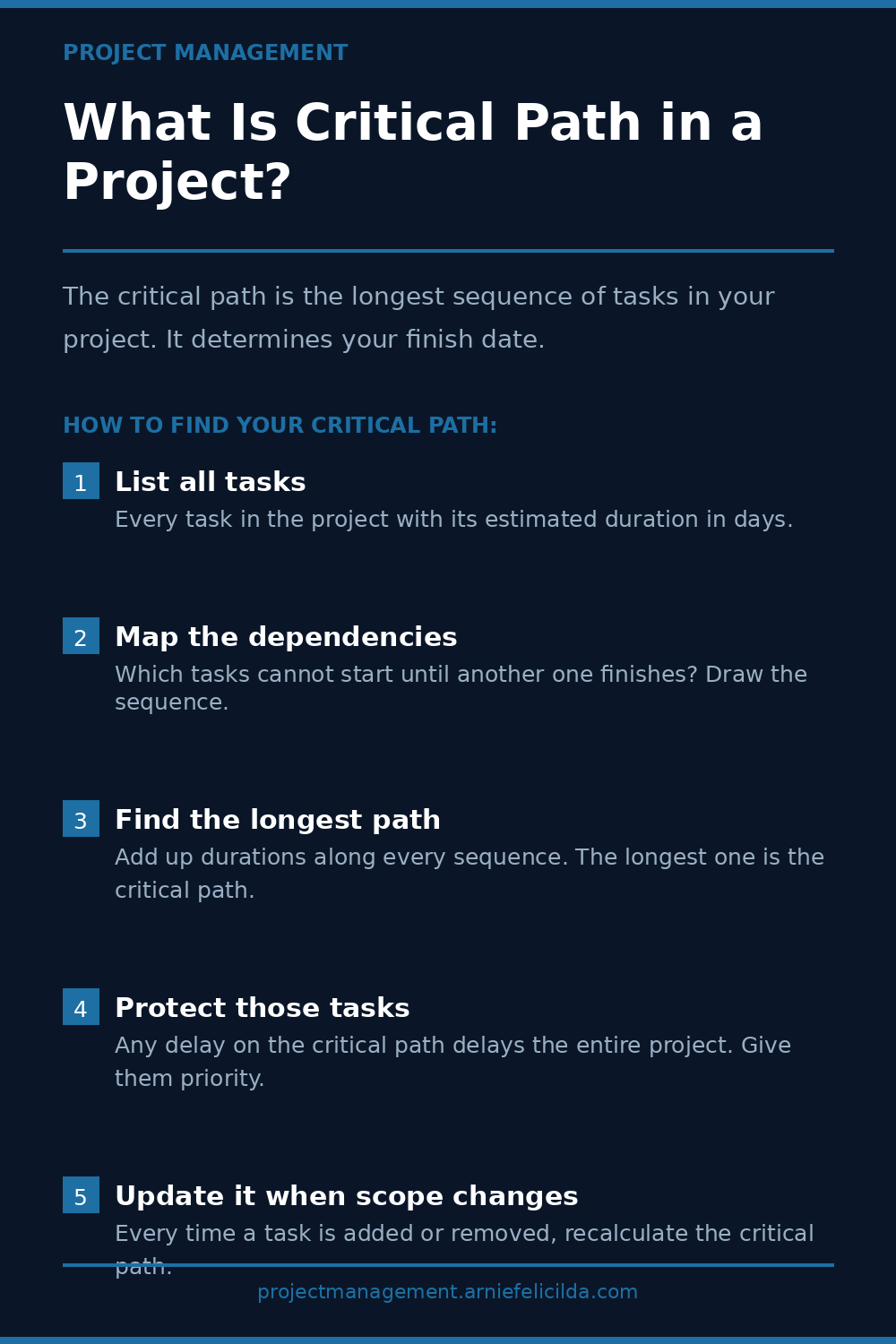
How to Find Your Critical Path
List All Tasks With Their Durations
Every task in the project with an estimated duration in days. Include only tasks that have a defined end point - not ongoing activities. If you cannot estimate the duration, that is a sign the task needs to be broken down further.
Map the Dependencies
For each task, identify which other tasks must be complete before it can start. These are the dependencies. Draw the connections. Some tasks have no dependencies - they can start immediately. Some cannot start until several other tasks are complete.
Find the Longest Path From Start to Finish
Add up the durations along every possible sequence from the project start to the project end. The longest total duration is the critical path. In a project with many parallel workstreams, there may be several paths that are close in length. The longest one controls delivery.
Mark Every Task on the Critical Path
These tasks get priority attention in every status review. When resources are scarce and two tasks are competing for attention, the critical path task wins. When a critical path task is behind, everything else becomes secondary until it is recovered.
Recalculate When Scope Changes
Adding or removing tasks changes the dependencies and potentially changes which path is longest. Every time a significant change is made to the project, recalculate the critical path. A change that appears to only affect a non-critical task can shift the critical path if the change adds enough duration.
When Critical Path Analysis Is Not Worth Doing
For short projects with few dependencies, a full critical path analysis adds more overhead than value. If your project has fewer than 15 tasks and runs for less than two months, a milestone list with dates achieves the same outcome with far less analysis effort.
For more on this topic, read What Is a Gantt Chart and Do You Need One?. You may also find What Is a Project Milestone and How to Set One useful as a next step.
Available Now
The Accidental Project Manager
For the person who was handed a project and told to figure it out. The 15-minute daily system, scope lock framework, and AI prompts that get any project back on track. No certification required.
Get the Book on Gumroad