Agile became popular in software development in the early 2000s as an alternative to the waterfall model, which required complete requirements before any development began. In software, requirements change constantly. Agile was built for that reality.
Since then, Agile has been applied to nearly every type of project in every industry, often without asking whether the conditions that make it effective are actually present.
What Agile Actually Is
Agile is not a specific tool or process. It is a set of values and principles that prioritize responding to change over following a plan, working incrementally over delivering everything at once, and continuous collaboration with stakeholders over comprehensive upfront documentation.
Agile is not the opposite of planning. It is a different approach to planning - planning in short cycles rather than once upfront. Teams that interpret Agile as permission to skip planning consistently produce worse results than those who plan carefully within each sprint.
When to Use Agile and When Not To
Use It When Requirements Will Change
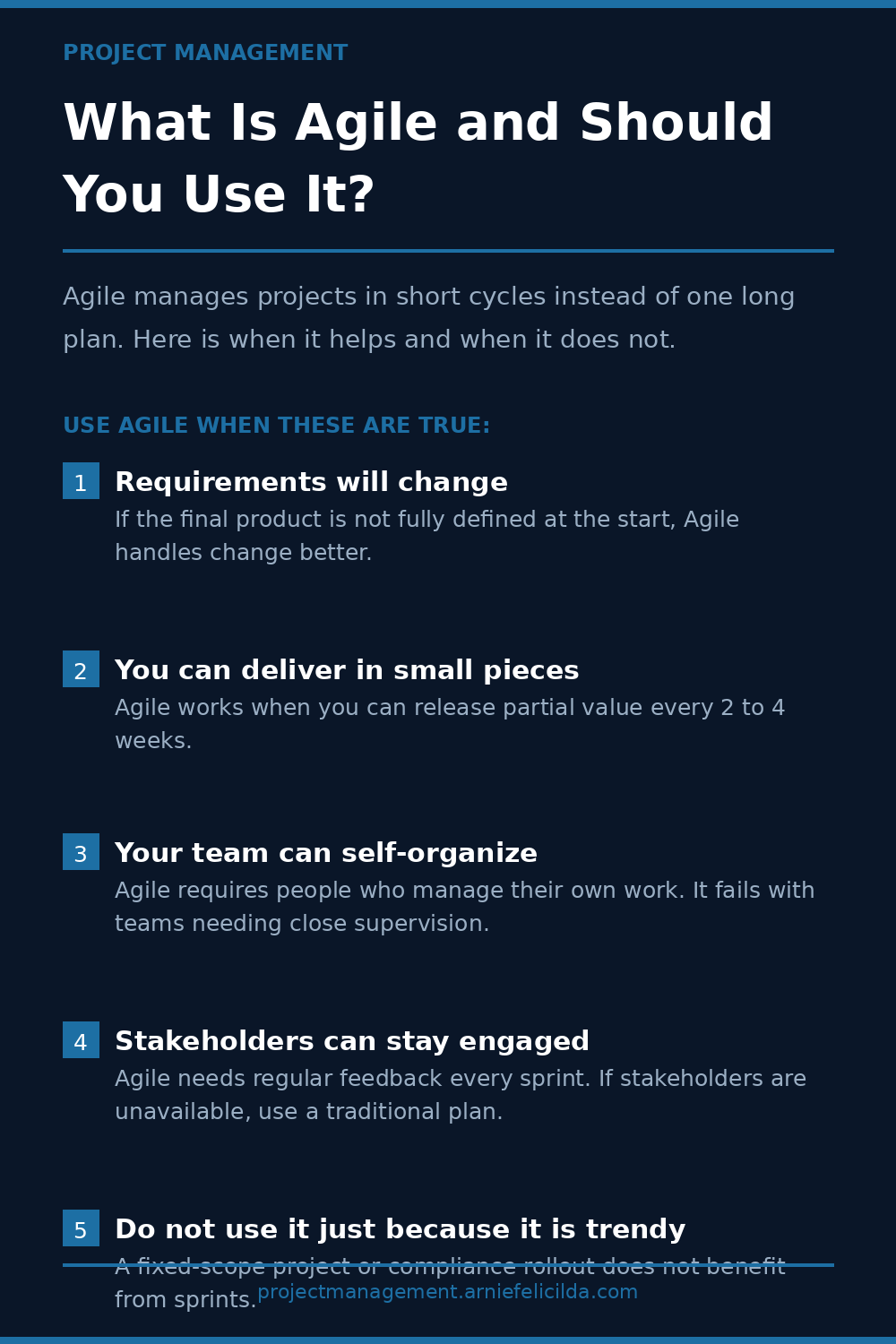
If the final product cannot be fully defined at the start because stakeholder needs will evolve, Agile handles that reality better than a fixed plan. Software, digital products, and creative projects often fall into this category. Fixed-scope contracts, regulatory projects, and construction projects typically do not.
Use It When You Can Deliver in Small Pieces
Agile produces value incrementally - a working version of the product at the end of each sprint that stakeholders can evaluate and respond to. This requires that partial delivery is genuinely useful. Some projects cannot deliver value partially. A bridge that is 40 percent built is not useful to anyone.
Do Not Use It When the Team Cannot Self-Organize
Agile requires team members who can manage their own work, estimate their own capacity, and flag their own blockers without being managed task by task. Teams that need close supervision to stay on track often perform worse under Agile because the structure that supports them is removed.
Do Not Use It When Stakeholders Cannot Stay Engaged
Agile requires stakeholder feedback at the end of every sprint. If the key stakeholders are unavailable for regular reviews, Agile loses its core feedback mechanism. Without that feedback, you are executing short sprints without the adaptation that makes them valuable.
Do Not Use It Just Because It Is Trending
A compliance rollout with fixed requirements and a regulatory deadline does not benefit from sprints. A construction project does not benefit from sprints. A project to implement a defined software package does not benefit from sprints. The question is not whether Agile is popular. It is whether the conditions for Agile success exist on your project.
Agile as a Mindset Rather Than a Methodology
Even on projects that do not use formal Agile methodology, the core Agile values are useful. Deliver something early and get feedback before you have invested too much. Stay responsive to change rather than defending the original plan. Keep communication continuous rather than saving it for formal reviews. These principles improve projects regardless of whether you are running two-week sprints or a traditional waterfall plan.
For more on this topic, read How to Write a Project Plan From Scratch. You may also find What Is Change Management in a Project? useful as a next step.
Available Now
The Accidental Project Manager
For the person who was handed a project and told to figure it out. The 15-minute daily system, scope lock framework, and AI prompts that get any project back on track. No certification required.
Get the Book on Gumroad