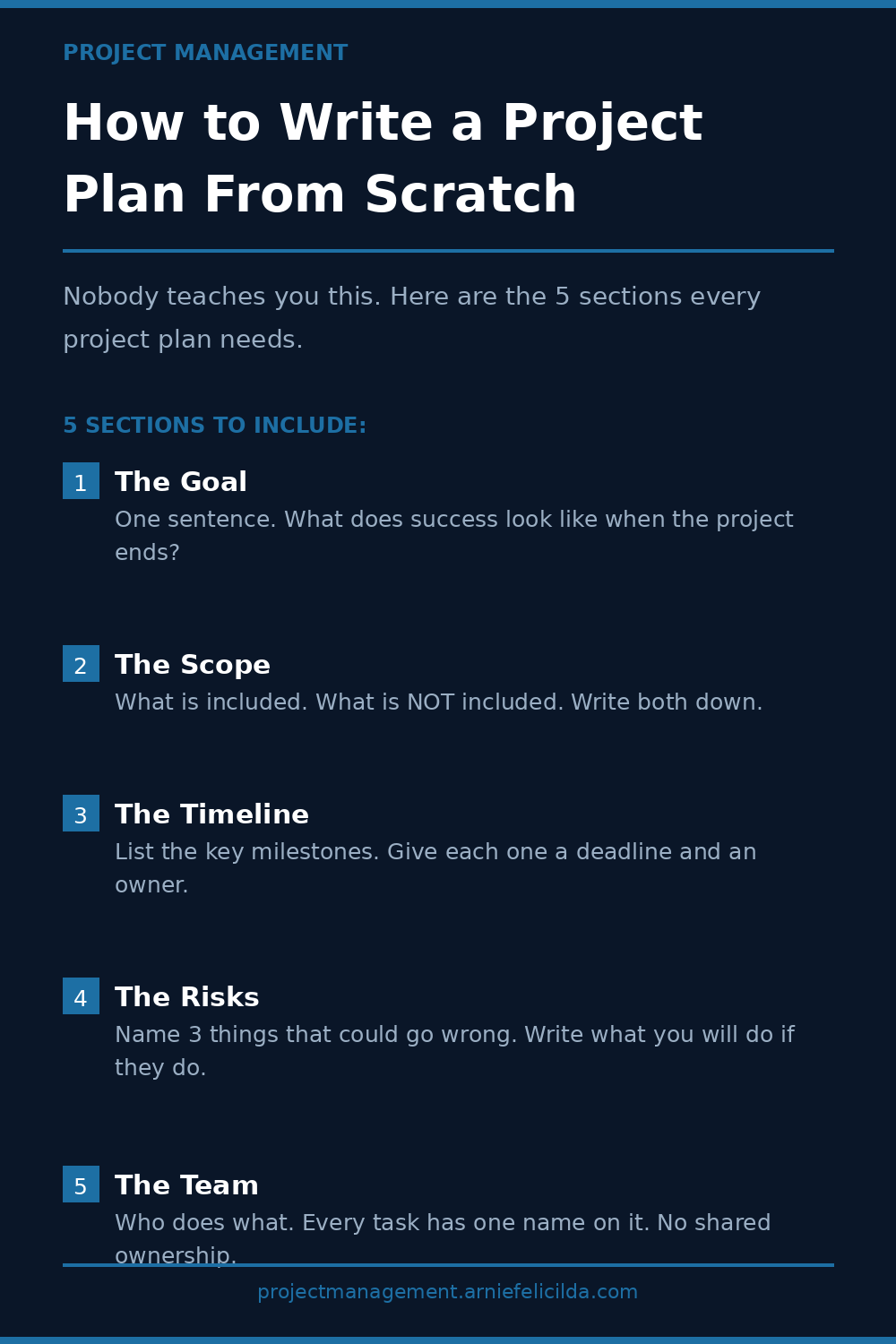
Most people who write their first project plan make it too complicated. They find a template online with 40 fields and spend a week filling it out before any real work happens. A project plan does not need to be complicated. It needs to answer five questions clearly.
Why a Written Plan Matters
A plan that exists only in your head is invisible to everyone else on the project. When team members have different assumptions about what the project includes, who is responsible for what, and when things are due, those differences surface as conflict during execution. A written plan surfaces them before work begins, when they are cheap to resolve.
The most important function of a project plan is not organizing the work. It is forcing alignment. When everyone reads the same document and agrees on it, you have alignment. Without the document, you have the illusion of alignment.
The 5 Sections Every Project Plan Needs
The Goal
One sentence. What does success look like when this project ends? Not the activities you will do. The outcome you will have achieved. A project goal that cannot be stated in one sentence is not yet clear enough to plan around.
The Scope
What this project includes and, equally important, what it does not include. The exclusions matter as much as the inclusions. Every scope dispute that derails a project traces back to something that was assumed to be included or excluded but was never written down.
The Timeline
The key milestones with specific dates and owners. Not a list of tasks - a list of significant completion points. Each milestone should be a thing that is finished, not a thing that is in progress. Assign one person per milestone who is accountable for it being done on time.
The Risks
Name three things that could go wrong. For each one, write one sentence about what you will do if it happens. This is not a comprehensive risk register. It is a basic acknowledgment that things go wrong and a minimal plan for the most likely ones.
The Team
Who is doing what. Not who is involved. Who is responsible for each deliverable. Shared responsibility is no responsibility. Every task on this project has one name next to it - the person who owns it and who answers if it does not get done.
How Long Your Plan Should Be
A project plan for most projects should fit on one to two pages. If it is longer than that, it is either a complex project that genuinely requires more detail, or it has become a document for its own sake rather than a tool for the team.
Write it, share it with the team, get agreement, and then use it as a reference point throughout the project. A plan that is written and never consulted is not a plan. It is an artifact.
For more on this topic, read How to Run a Project Kickoff Meeting. You may also find What Is a Project Milestone and How to Set One useful as a next step.
Available Now
The Accidental Project Manager
For the person who was handed a project and told to figure it out. The 15-minute daily system, scope lock framework, and AI prompts that get any project back on track. No certification required.
Get the Book on Gumroad