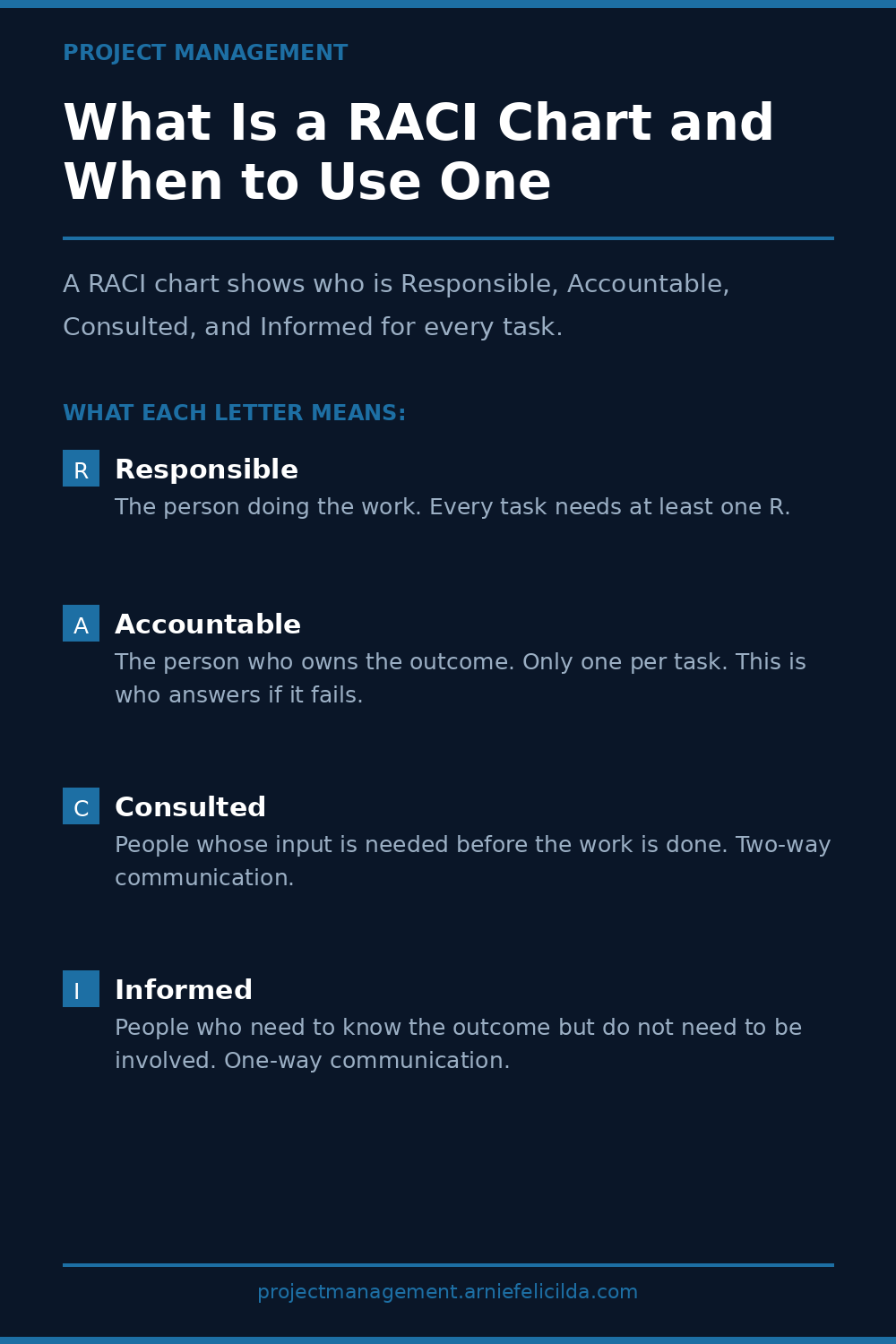
Most project conflicts trace back to role ambiguity. Two people thought they owned the same decision. Nobody thought they owned a task, so it did not get done. Someone made a decision that affected another team without consulting them. A RACI chart prevents most of these conflicts by making the answers explicit before work begins.
What Each Letter Means
R - Responsible
The person doing the work. For any task, the R is who executes it. There can be more than one R on a task if multiple people are genuinely working on it together, but this should be the exception rather than the rule.
A - Accountable
The person who owns the outcome. There can only be one A per task or decision. The A is who answers if the work does not get done or does not meet the standard. The A often delegates execution to an R but retains ownership of the result.
C - Consulted
People whose input is sought before the work is done or the decision is made. Consulted means two-way communication - their input is genuinely considered, not just noted. Being consulted does not mean having veto power. It means being asked.
I - Informed
People who are notified of the outcome after a decision is made or a task is completed. Informed means one-way communication. They do not contribute to the decision. They need to know about it because it affects them or their work.
When to Use a RACI Chart
A RACI chart is most useful for projects with multiple teams, complex decision-making, or a history of role confusion. For a small project with a clear team and simple structure, it adds overhead without much benefit. The question to ask is: is there meaningful ambiguity about who owns what on this project? If yes, a RACI chart is worth building.
A RACI chart with too many As is a sign that accountability has not been genuinely assigned. Every task with two As has the same problem as a task with no As - when something goes wrong, there is a conversation about whose responsibility it actually was.
The Most Common RACI Mistake
Filling in the C and I columns with too many names to avoid conflict. When everyone is consulted on everything, the chart adds process without adding clarity. Consult only the people whose input will genuinely change or improve the decision. Inform only the people who need to know to do their own work. Keep both columns short.
For more on this topic, read How to Get Stakeholder Buy-In Before the Project Starts. You may also find How to Run a Project Kickoff Meeting useful as a next step.
Available Now
The Accidental Project Manager
For the person who was handed a project and told to figure it out. The 15-minute daily system, scope lock framework, and AI prompts that get any project back on track. No certification required.
Get the Book on Gumroad