Most project budget problems are not math problems. They are category problems. Something significant was not accounted for because the person building the budget did not have a framework for what to include. By the time the missing cost appears, it is too late to plan around it.
The Two Types of Project Cost
Direct costs are expenses that exist specifically because of this project - labor, materials, software licenses, vendor fees. Indirect costs are shared expenses that apply to this project proportionally - overhead, facilities, management time.
Most project budget overruns come not from direct costs being underestimated, but from indirect costs being omitted entirely. Management time, internal review cycles, and shared infrastructure costs are real costs even when no money changes hands externally.
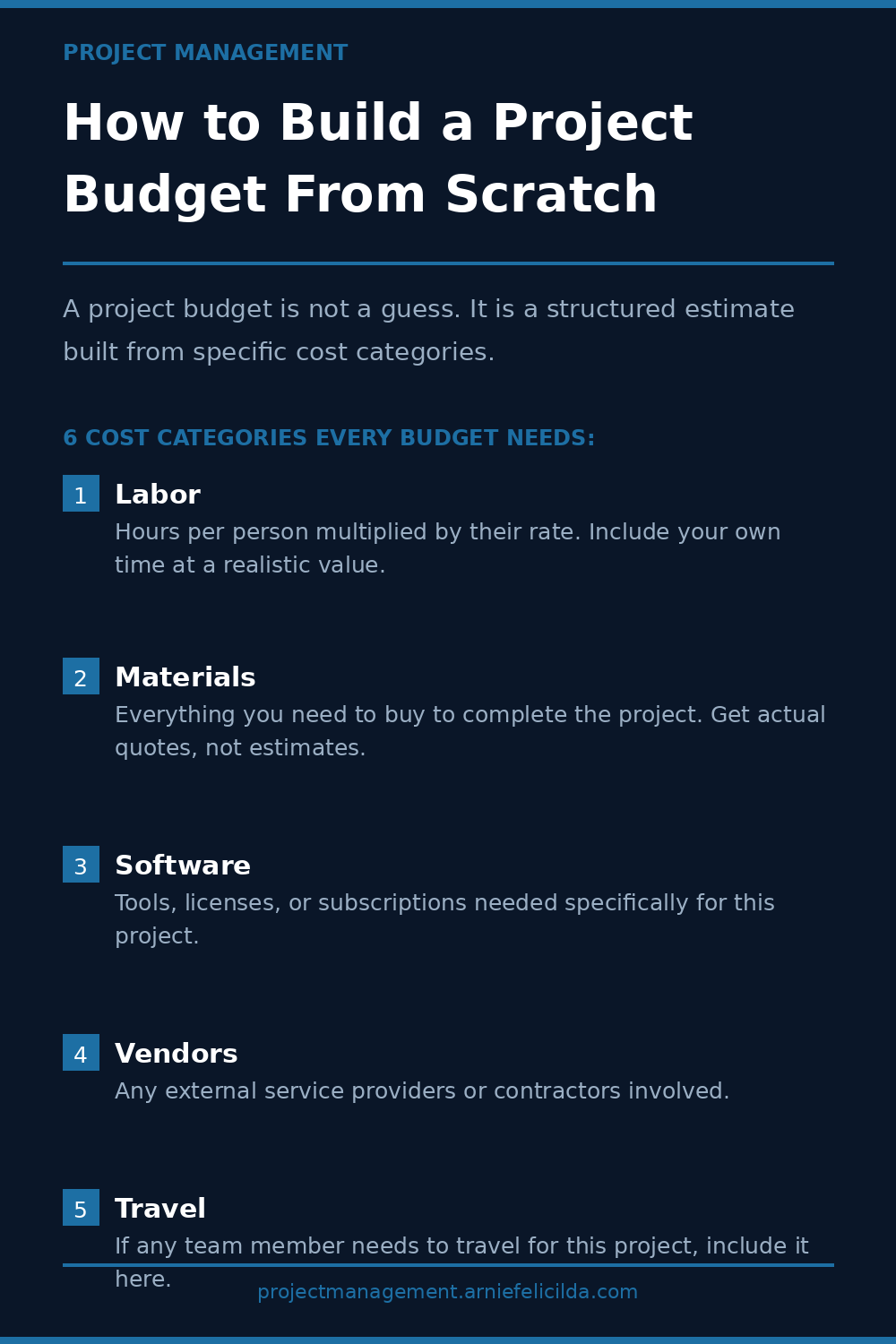
6 Cost Categories Every Budget Needs
Labor
Hours per person multiplied by their loaded cost rate. For employees, the loaded rate includes salary plus benefits plus overhead - typically 1.3 to 1.5 times the base salary. Include your own time at a realistic rate. Management time on projects is rarely free.
Materials
Everything you need to buy to complete the project. Get actual quotes from suppliers rather than using estimates or remembered prices. Material costs that are estimated rather than quoted are where most project budgets first diverge from reality.
Software and Tools
Any tool, license, or subscription required specifically for this project. Include one-time setup costs and recurring costs through the project duration. A project that runs for six months requires six months of any monthly subscription, not one.
Vendors and Contractors
Any external service providers, contractors, or agencies involved. Get fixed-price quotes wherever possible. Time-and-materials vendor arrangements require a budget estimate plus a contingency, because the final cost is not known at the time of budgeting.
Travel
If any team member needs to travel for this project, include flights, accommodation, and ground transport at actual booked rates where possible, or at company travel policy rates where not yet booked.
Contingency
Add 10 to 15 percent on top of your total estimate. Something always costs more than planned. Contingency is not padding - it is an acknowledgment that estimates are estimates. A budget with no contingency assumes perfect forecasting, which has never happened on any project anywhere.
How to Present Your Budget
Present the budget by category with the source or assumption behind each number. A budget presented as a single total is easy to challenge. A budget broken into six categories with a one-line justification for each is much harder to dismiss. Show your work.
For more on this topic, read How to Write a Project Plan From Scratch. You may also find What Is Change Management in a Project? useful as a next step.
Available Now
The Accidental Project Manager
For the person who was handed a project and told to figure it out. The 15-minute daily system, scope lock framework, and AI prompts that get any project back on track. No certification required.
Get the Book on Gumroad